

How to Prepare Your Clinic for the DOH - Clinical Costing Abu Dhabi
16/03/2026
From corporate tax registration to audits and bookkeeping, Young & Right offers personalized solutions that keep your business compliant and stress-free. Let’s take the complexity off your plate—starting with a free consultation.
Book Your Free Consultation

Healthcare organizations are increasingly focusing on hospital clinical costing Abu Dhabi to improve financial transparency and operational efficiency. As healthcare systems grow more complex and regulatory expectations increase, hospitals must accurately measure the cost of delivering patient care. Implementing structured clinical costing frameworks helps healthcare providers track medical service costs, allocate resources effectively, and maintain compliance with healthcare financial reporting standards.
Hospital clinical costing refers to the process of calculating the actual cost of healthcare services delivered within a hospital. This includes tracking expenses associated with patient treatments, diagnostic procedures, staff involvement, medical equipment, and operational infrastructure.
In Abu Dhabi, healthcare providers operate under the regulatory oversight of the Department of Health – Abu Dhabi, which encourages healthcare facilities to maintain transparent financial records and accurate costing systems.
Clinical costing enables hospitals to connect clinical activities with financial data. By doing so, healthcare organizations can understand the real cost of delivering different medical services and identify areas where efficiency can be improved.
Hospital clinical costing plays a critical role in modern healthcare financial management. Hospitals must balance patient care quality with financial sustainability, making accurate cost tracking essential.
Key benefits include:
By implementing structured costing models, hospitals can gain deeper insights into their operational costs and make informed strategic decisions.
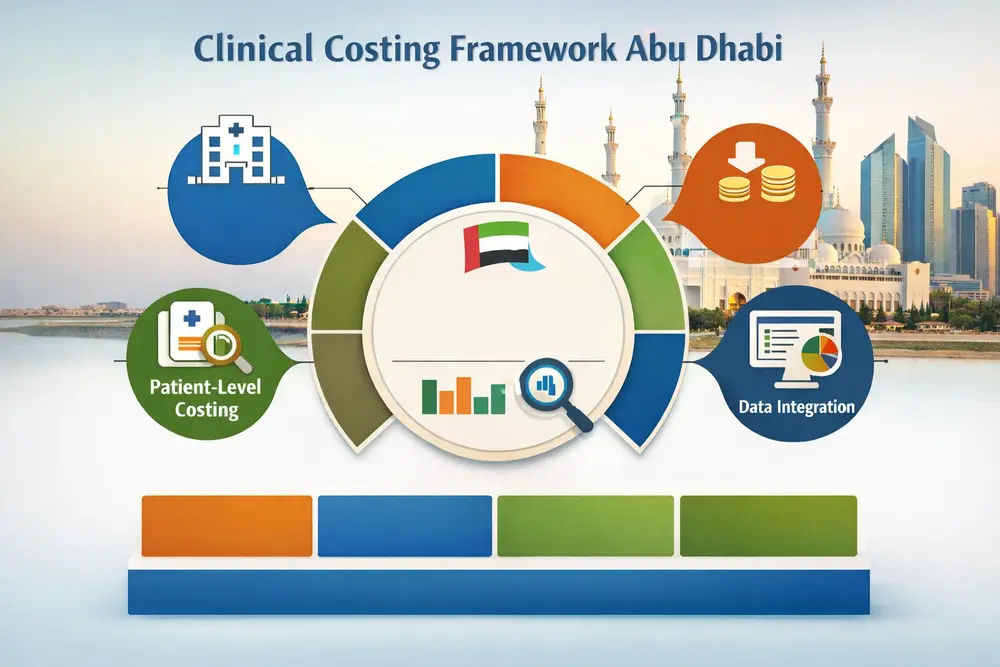
A well-designed clinical costing framework consists of several important elements that work together to provide accurate cost insights.
Hospitals are made up of multiple departments, each with its own operational expenses. Establishing clear cost centers is essential for tracking costs accurately.
Typical hospital cost centers include:
A well-defined cost center structure allows hospitals to allocate expenses to the correct departments and analyze departmental performance.
Activity-based costing is a common methodology used in hospital clinical costing. It tracks the resources consumed during specific healthcare activities such as consultations, imaging tests, surgeries, and laboratory procedures.
Each activity is assigned a cost based on the resources required to perform it. These costs are then aggregated to determine the total cost of treating a patient.
This approach helps hospitals identify high-cost services and optimize their operational processes.
Hospitals incur both direct and indirect costs when delivering healthcare services.
Direct costs include:
Indirect costs include:
These indirect costs must be distributed across departments using structured allocation methods to ensure accurate costing.
Modern hospital operations rely on multiple digital systems that generate valuable clinical and financial data.
These systems include:
Integrating these systems with clinical costing platforms allows hospitals to capture detailed data about patient care activities and calculate accurate service costs.
For clinical costing to be reliable, costing data must align with the hospital’s financial records. This requires reconciling costing datasets with accounting reports such as the general ledger.
Reconciliation ensures that the total costs captured in the clinical costing system match the hospital’s financial statements.
Technology plays an essential role in modern healthcare financial management. Many hospitals now implement specialized clinical costing software to automate cost tracking and reporting.
These digital platforms help hospitals:
Automated systems reduce manual errors and provide management teams with real-time financial insights.
Hospitals operating in Abu Dhabi must comply with financial transparency and reporting standards established by the Department of Health – Abu Dhabi.
Clinical costing frameworks help hospitals meet these regulatory requirements by providing detailed information about healthcare service costs.
Accurate costing data supports healthcare policy planning and helps regulators evaluate the efficiency of healthcare delivery across the region.
Despite its benefits, implementing hospital clinical costing systems can present several challenges.
Common challenges include:
Healthcare organizations must address these challenges through proper planning, technology adoption, and professional financial guidance.
Strategies to Improve Hospital Clinical Costing
Hospitals can strengthen their clinical costing systems by implementing several best practices.
Develop Clear Cost Center Structures
Hospitals should define departmental cost centers clearly and ensure expenses are mapped accurately.
Implement Advanced Costing Software
Modern clinical costing platforms automate data collection and provide detailed cost analytics.
Conduct Regular Financial Reviews
Periodic reviews help hospitals identify inefficiencies and improve operational performance.
Improve Data Integration
Healthcare organizations should ensure that hospital systems are integrated with the costing platform to capture accurate operational data.
Train Finance and Clinical Teams
Staff training ensures that both financial and clinical teams understand costing processes and use systems effectively.
Implementing effective hospital clinical costing systems requires specialized expertise in healthcare finance and regulatory compliance.
Young and Right Accounting and Tax Consultancy provides professional advisory services that help hospitals and healthcare organizations implement accurate clinical costing frameworks.
The firm works closely with healthcare providers to improve financial transparency and operational efficiency.
Clinical Costing Framework Development
Young and Right helps hospitals design structured clinical costing models that accurately track treatment costs and operational expenses.
Cost Center Structure Design
The consultancy assists hospitals in creating well-defined departmental cost centers to ensure accurate cost allocation.
Financial Data Reconciliation
Healthcare providers receive support in reconciling costing data with accounting records to maintain consistency between financial systems and costing reports.
Healthcare Financial Reporting Support
Young and Right helps hospitals prepare financial datasets and reports required for internal management and regulatory purposes.
Regulatory Compliance Guidance
The firm supports hospitals in maintaining compliance with financial reporting standards set by the Department of Health – Abu Dhabi.
By working with experienced healthcare financial consultants, hospitals can implement reliable clinical costing systems that support long-term financial sustainability.
Long-Term Benefits of Hospital Clinical Costing
Hospitals that implement structured clinical costing systems gain several long-term advantages.
These benefits include:
Clinical costing also supports strategic planning by providing detailed insights into the financial performance of healthcare services.
Accurate cost management is essential for healthcare organizations operating in a complex and highly regulated environment. Implementing hospital clinical costing Abu Dhabi systems enables hospitals to measure treatment costs accurately, improve financial transparency, and optimize operational performance.
By integrating hospital systems, implementing structured cost allocation methods, and adopting advanced healthcare financial technologies, hospitals can build stronger financial management frameworks.
With the right processes, technology, and professional advisory support, healthcare providers in Abu Dhabi can successfully implement clinical costing systems that enhance both financial efficiency and patient care outcomes.
Hospital clinical costing in Abu Dhabi is the process of calculating the actual cost of healthcare services delivered by hospitals. It involves tracking clinical activities, medical resources, and operational expenses to determine the true cost of patient care while ensuring compliance with regulations from the Department of Health – Abu Dhabi.
Clinical costing helps hospitals understand the real cost of treatments and procedures. This improves financial transparency, supports better budgeting, and helps healthcare providers manage resources efficiently.


Get expert support to implement accurate clinical costing systems and meet healthcare financial reporting standards in Abu Dhabi.
Book a Free Consultation